Organic Wine Podcast
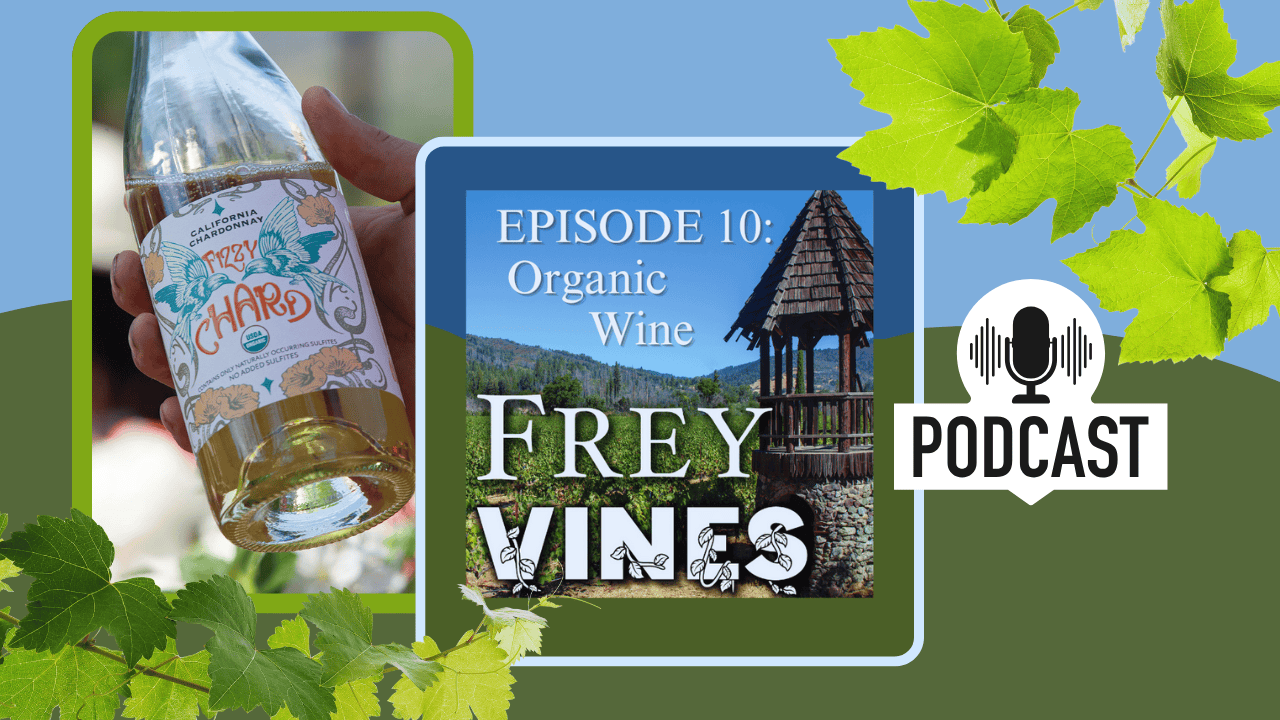
The Frey Vines Podcast, Season 2, Episode 10: “Organic Wine”
Frey Vines, the Organic Wine Podcast, is sharing everything about making organic wine in this 10th episode. We delve into how we make organic wine, why we make only organic wine, and what we think you need to know about making organic wine at Frey Vineyards. Molly Frey sat down for an interview with Eliza Frey to share about our best practices and how we are committed to organic wine at every step of the process. Open a bottle of your favorite Frey Organic wine while listening to us share all about how your favorite wines are produced!
You can listen to the Organic Wine Podcast on your favorite podcast streaming platform, or you can watch the episode on our YouTube channel.
MOLLY FREY: Welcome to the tenth episode of the Frey Vines podcast, telling the story of organic wine. Today we’re looking at how organic wines are made, what makes organic wines unique, and why we only make organic wines at Frey Vineyards.
ELIZA FREY: So organic wine has to be made from organically grown grapes. And then it also needs to be processed organically. Organic wine needs to be processed without the use of any synthetic additives or processing aids, and so the one that comes up most frequently is sulfites.
Sulfites are a chemical preservative that have been used for a long time in wine making. We choose not to use them or use any other synthetics. There are different synthetically produced enzymes that are used. There are yeast nutrients that are processed from fossil fuels. There are sugars and colors and flavors and stabilizers and all sorts of different tricks and tools that people have come up with to make wine making more predictable.
And one of the things that we believe is that if you have high quality fruit, then you can come up with a good wine just within the natural fermentation process and the natural aging process. And it's not necessarily our goal to have our wine taste and look the exact same season after season. And so that also is kind of a question of scale. When things start to get really big, people tend to want more control. And so then the additives and preservatives and processing aids just come.
It was interesting for me learning, going to kind of mainstream wine making meetings, because I had grown up, you know, just making wine at Frey Vineyards and people are like, “well then we just bring up the tartaric acid to this level and we bring up the citric to this level and then we add the color to get it to this level.” And I'm like, oh, you can just do that. You know? So it's a little bit of a philosophical difference. So, USDA organic wine needs to start with organic grapes and be all the way through the processing a hundred percent organic.
MOLLY: When Frey Vineyards became the first organic winery over forty years ago, we were simply trying to make a high quality wine to enjoy. The Frey family is full of organic farmers who were growing organic grapes on the family land. When they started to experiment with becoming organic winemakers, they wanted an organic yeast to use for making organic wine. When the winery started, there wasn’t an organic yeast on the market.
ELIZA: Yeast was an issue within the organic sphere because when the USDA first came out with the National Organic Program, they did not address yeast. And yeast is used in many different products and the concerns with having a certified organic yeast have to come from the substrate or what the yeasts are grown on because basically yeasts are cultivated in a very controlled, clean environment, and then they're freeze dried and then like a bread yeast that you would buy at the store, you wake them up with water. And so one of the issues that we found is that the sugars that they were fed when they were being grown, in order to then be freeze dried and sold, a lot of it was sugar beet, which is, GMO or other non-organic sugar-based substrates to feed out the yeasts.
And so my uncle Paul definitely gave feedback to the USDA about the need to really clarify that yeast also needs to be organic, and so that's a loophole that the National Organic Program has closed up. Now they have certified organic yeast. There's only a few producers who make them, but for our organic wines, many of them we do inoculate with a yeast that we buy from a supplier, and that whole thing is certified organic as well.
MOLLY: In Biodynamic winemaking, we don’t add any yeast to the wines to really allow the natural fermentation of the grapes to come through in the terroir. Our Biodynamic wines are all made from grapes grown on our home ranch, and they don’t travel very far between the fields and our winery, so it’s very easy to use the native yeast for their fermentations.
However, the Biodynamic wine-making standard currently allows for Biodynamic wines to be made with the addition of some sulfites, but at Frey we are committed to producing no sulfites added wines, so we never add any sulfites to any of our wines. For this reason, our Biodynamic wines are also certified organic, because the USDA organic seal on each wine label is our way of showing you that no sulfites or additives are ever added to any of our wines.
ELIZA: So for our organic line, we add certified organic yeast that we buy from a producer. But when we make our biodynamic estate grown wines, we aren't adding any yeast. We’re relying on the native yeast in the vineyard and in the cellar to carry out the fermentation. But one thing that we do do is we kickstart the fermentation by having a small batch of grapes. What we usually do is just pick a row or two of grapes and have it out in the vineyard in a vat as a native vat fermentation.
And so that needs to be managed really closely. It needs to get mixed several times a day, and so that for about three to seven days will live in the vineyard and get stronger, and you can watch it over time. First, it's just grape juice sitting there. Then it starts to bubble, then it kind of peaks and the gases are coming off and you start to smell the alcohol and the whole flavor's changing, and the color's changing. And the juice is getting darker every day with the seed extraction. And so for our biodynamic wines, once that native yeast, small batch fermentation is going really well out in the vineyard. We will bring that to the winery with the remainder of the fruit in the vineyard and it will get put into the tank and it acts as an inoculant to start up.
So it's like a sourdough starter that we do in the vineyard where we have a small batch of grapes start the fermentation and add it to the batch to really get it off on a strong and healthy fermentation path. When our winery first started, we did vats, open vats, and there you do what's called punching down. And so you would use either a metal, some people use plastic or or wooden pat paddle. And so it's kind of like a flat top with a handle, and with that, you push the cake down and mix it in, and that has to be done again, multiple times per day.
As we moved into larger batch wine making and into the tank paradigm where we're fermenting in large stainless steel tanks. we use pumping over, which is where the skins and seeds float to the top. But you can pump juice outta the bottom of the tank, threw a hose up to the top of the tank, and wet down and mix in the cap from above. And that works very well. It's very labor intensive, but the method that we've been using more recently is um, pulse air or air bluff. So we're actually using filtered, compressed air and from the bottom of the tank, we just send air bubbles up through the liquid and that as the bubbles burst the surface, they break open the cake and everything just mixes.
And for a lot of factors, (safety factors, time factors) that has become really an efficient, um, it's also a gentler way to mix the skins and seeds in with the grapes because you're not sending the liquid through that whole pumping cycle as repetitively. You're just using air to basically boil, although there's no heat involved, but basically that bubbling boiling motion mixes the skins and seeds. So that's been a really, a really great technique that we've adopted.
So there's a lot of heat created in fermentation, and that's one thing that we look at, is making sure our fermentations don't get too hot. So we will use refrigeration techniques, or we'll use refrigeration on our vats of wine as we're fermenting them to maintain the ideal fermentation temperature, which again, depending on the style of wine you're making is different. Our white wines we ferment very slowly and coolly, and our red wines go a little faster, but we're looking to never let that temperature get as high as it could. Temperatures can really spike when there's a large fermentation going on. Another thing during fermentation that's happening is a lot of carbon dioxide and other gases are being off-gassed by the yeasts. It’s very important to mix that and release that. And that's something anyone who's ever done, even a small batch fermentation or punching down, you know that when you mix in, you get this kind of heady aroma of, and it can even make you a little dizzy, high levels of carbon dioxide. So, so that's part of the pumping over or mixing process as well is doing that release of the fermentation, the natural fermentation gases that are, that are a byproduct of the yeast metabolism.
MOLLY: The length of time that a red wine sits with its skins and seeds changes the character of the finished wine. We pay careful attention to temperature and we taste daily to decide when to separate the liquid from the solids. This is when art comes in, because more or less exposure will change nuances in the finished product.
ELIZA: Once the red wines are at a place where we want to press them, we transfer the wines with hoses and pumps into a large press, and the presses that we use in the cellar are called bladder presses. So they're large vats and they can spin and they have drains in them. And then there's what's called a bladder and it’s a food grade, basically giant, very heavy-duty sack. And the presses that we have use compressed air. There are mechanical presses and those will be like the old wine presses you see, that's how we used to do everything. Or if anyone's ever made apple cider where you kind of crush up the fruit material and put it in, and then you crank it down with like a screw. The presses that we use now are not mechanical. They're, they're, they use air, and the air pressure as the bag expands, pushes the liquid through the drains, and all of the grape material is left inside the press and then can be, once the liquid is drained off, that grape material gets emptied, put into dump trucks and taken out to be composted. So, once the wines are pressed, there's still a lot of, right after the red wines are pressed and the whites, they're, the juice is very cloudy for several weeks as it finishes fermentation. And so then we have what's called a settling that happens.
MOLLY: After pressing, wines starts the maturation process. Solids settle out, and are discarded as the wines clarifies.
ELIZA: So a lot of the solids that are a part of the grape juice mixture, the solids fall to the bottom of the tank and collect, and the name for that material is lees. That's what falls. So there are the leftovers of the yeast, once they finished their process, there's also proteins and fibers and sugars, and so as those settle out, it's kind of like a sludge that forms at the bottom of the tank.
So the process that happens after pressing, after about a month and a half or so is called the first racking. And racking is when you remove clear liquid off of the top of a tank or barrel. It happens in barrels as well, and leave behind the more solid, sludgy material of lees. And so we usually do two to three rackings per wine. It totally depends on the wine and what style we're doing. And so usually if we finish picking grapes by about the beginning of November, after about one month, we will have racked the clear wine off the top of the gross lees, gross meaning big. So there's gross lees and fine lees. Gross lees are the first batch of lees that are collected.
MOLLY: After racking, secondary fermentation smooths out flavors and stabilizes the wine.
ELIZA: Really, wine undergoes two fermentations. They are referred to as primary and secondary fermentations, but another way they can be referred to is alcoholic fermentation and malolactic fermentation. So I think the one people are most familiar with is alcoholic fermentation or primary fermentation that is, um, carried out by yeast organisms. Yeast are microscopic living. Creatures and they eat sugar and their byproduct is alcohol. But once that happens and the wine is in what I would call a rough young states not super delicious to drink, yet, not clear, still cloudy, the flavors aren't polished or refined, it’s not what you would, you know, expect a delicious glass of wine.
So when wines are freshly pressed and have carried out their alcoholic fermentation, that’s when all of the sugar has been consumed and converted into alcohol. There's a secondary fermentation that takes place, which is by a bacteria. It's a bacterial fermentation and it's called malolactic bacteria. So malolactic fermentation is a bacterial fermentation in which small bacteria change malic acid, which is a natural component of grape juice. They convert that through their metabolism into lactic acid. And what happens when that kind of magical fermentation occurs is the quality of the wine changes. It tastes smoother, it tastes less bitter. The feeling in the mouth is nicer. And the wine just tastes more finished and delicious. Malolactic fermentation happens naturally.
A lot of people inoculate for it, and we'll can use like a freeze dried bacteria to inoculate for it, which we do use sometimes. It also happens in native fermentations, but it takes longer, and so depending on the timeframe of when a given wine is going to be produced, wine makers will kind of kickstart these natural processes that would happen anyway in order to get to the finished, complete, balanced form of the wine. That's the end goal of of wine making.
For questions or comments about the content shared here, Frey Vineyards or Frey Wines, you can email info@freywine.com or call Our retail staff is happy to help you. Monday through Friday, 9:00 AM to 5:00 PM Pacific Standard Time. Thank you for joining us for this episode of the Frey Vines podcast, telling the story of organic grapes. This episode of the Organic Wine Podcast concludes our podcasting for our second season. Thank you for tuning in to learn more, celebrate organics, and sip sustainably! Cheers!